Obama backs Marriage Equality

In what is probably going to be the biggest news of the week, US President Barack Obama has officially declared his support for marriage equality in the USA, evoking responses such as the picture you see here.

video platform video management video solutions video player

So far the best analysis of this has been at The New York Times, who note that this comes after 2 years of Obama’s ‘evolving’ stance of marriage equality despite the widespread belief that he personally supported it. Of course, in America the fear is of alienating the strong religious voters, which is fairly obvious if you read between the lines:

“I had hesitated on gay marriage in part because I thought that civil unions would be sufficient. I was sensitive to the fact that for a lot of people, the word marriage was something that invokes very powerful traditions and religious beliefs.” – Barack Obama

However, the NY Times quite rightly pointed out that there’s been a lot of electoral pressure on Obama to evolve and take a stance, especially given his upcoming political engagements:

“On Thursday, Mr. Obama is to visit the Los Angeles home of the actor George Clooney for a campaign fund-raiser expected to raise about $12 million, much of it from Hollywood people active in the gay rights cause.

Mr. Obama is scheduled to give the commencement address next week at Barnard College in New York City, where he will receive a medal along with Evan Wolfson, the founder and president of Freedom to Marry, a leading advocate for same-sex unions. Mr. Wolfson, who had written that he would “whisper in the president’s ear” to support same-sex marriage, said in an interview on Wednesday, “I’m going to shout, ‘Thank you!’ ”

Also on Monday, Mr. Obama is to speak at a campaign fund-raiser for gay rights supporters. And on June 6, he is to return to Los Angeles to speak at a gala benefiting the gay, bisexual and transgender community.”Jeff Zelen, New York Times.

This, of course, raises speculation that Obama is announcing his newly evolved stance specifically to avoid having to dodge questions on the subject or otherwise avoid the issue, as well as an attempt to galvanise his support in the run up to the US election. On the other hand, does it matter? One of the goals of the marriage equality movement has always been to get enough support for equality that it became politically viable for politicans to endorse change–preferably that it became untenable for them to oppose it, especially in a democracy. Whatever the cause of the change, Barack Obama has decided it is politically beneficial for him to do the right thing and support marriage equality, or at the very least, it is no longer politically disadvantageous to do so. This is a good thing.

So sparkly rainbow unicorns aside, I would like like you all to join me in saying ‘Thank You’ to Barack Obama, and showing all world leaders that there is global support for Marriage Equality. AllOut.org would like to send the world’s biggest thank you card to Obama on Friday (US time), and they need your signature (digital or otherwise) on it. To sign the card, just click here, and in the lead up to International Day Against Homophobia (IDAHO), say thanks to those polticians who are brave enough to get up and make a stand for equality, and showing a commitment to enabling all human beings to be free and equal in dignity and rights as enshrined in the Universal Declaration of Human Rights.

Public Transport: The Cost of Delays

One of the things you get told about authors is that the majority of us work at least two jobs: writing, and something else that pays the bills. As an indie author just starting out, that certainly applies to me. So each weekday, I haul myself out of bed, ignore the enticements of my computer and head into the city to work, along with a large chunk of the state’s population. And like a fair number of those people, I take the train.

Anyone following me on Twitter will see the daily fun I get with the amount of delays our service provider, Metro Trains throws my way. To be fair, Metro have inherited an aged system that is in dire need of upgrading and a fairly non-functional ticketing system mess (as well as a culture of fare evasion), but at the same time, there is a rather…large…variability in their actual running times which can make planning your run into work a complete pain. On my particular line, the run time can be anywhere from fifteen minutes without delays, to twenty five or thirty minutes, with the train sitting idle on the track waiting for another to clear a platform, sneak in ahead on a different line, or for some other reason that is rarely explained. The upshot of which is I can be made late for work. Which is something I can only assume affects other people as well, and this lost productivity time must be worth something, right? So I set out to see if I can calculate how much this would be.

Without any clear numbers (that I could find) as to how many people travel during morning peak (defined by the government as between 7:00 and 9:30 AM), I decided to calculate train capacity and work off that. Across all lines, Metro runs 514 services that start between those times, according to the timetibles on the public transport victoria website. According to their fleet information, they also have enough trains to run 36 Siemens 6 carriage trains (max capacity 1584), 93 Comeng 6 carriage trains (max capacity1526), 7 Hitachi 6 carriage trains (Seated capacity of 1072), and 59 X’Trapolis trains (capacity of 794). These are official capacity numbers, which should suffice for calculations, as this should average out, despite the knowledge that as of October 2011, 15.9% of trains in the morning peak hours were overcrowded. This information also presumes that Metro uses all its trains equally and preferences trains with higher capacity rather than lower capacity, giving us a daily total of 697876 passengers across 514 train trips (3 trips for each of the Siemens trains and most of the Comeng trains, and 2 trips for all the others).

Assuming that every passenger is, on average, delayed by five minutes as I was this morning, how much does that cost in lost productivity?

There’s a couple of ways to calculate this. Assuming that about 60% of train passengers are city workers, as opposed to students or people braving the peak hour crush for some strange reason, that’s 418737.6 people (on average) being delayed each day. With the average Victorian salary being $65,608, this means that I am massively underpaid and that on average, a Victorian worker earns $0.0525705 per minute, and $2.628526 in that five minute delay (going on a 52 week working year 5 days a week and an 8 hour work day). This is a cost of $1,100,662.52 in lost productivity across the train travelling population each day.

But wait, the critics say, not everyone is earning $60K a year, and most of those high earners aren’t going to be taking the train, let’s be honest. Okay, let’s try this another way. Say that all of the 697876 daily passengers are losing 5 minutes of their time a day, how much is that time worth? Well, if they all went out and got a minimum wage job, they’d be paid $15.51 per hour, or $1.2925 per five minutes. Of course, you may say your time is worth more than $15.51 per hour, but we’re being conservative here. So this means that the cost is $902,030.58.

This means, given my fairly conservative estimates, a five minute delay across the peak hour trains is costing Victoria between $900,000 and $1.1 Million each day in lost productivity, whether that’s time that could be spent working, sleeping, eating, staying healthy or doing any number of those things that we do to keep ourselves sane. So hello Metrotrains. That’s what you’re doing to Victoria. Please fix it. I ask you every day but as yet I’m not gettin any responses. Maybe one day you’ll tweet back. Maybe one day pigs will fly. Or maybe one day, Melbourne’s trains will run on time. When will that be? Well, that’s literally the million dollar question.

Writerly Rambling: Repetition, Repetition, Repetition

One of my friends pointed me towards a rather strange sentence recently, and after reading it over and over and over again, I eventually caved and went to see its wikipedia page. The sentence, which makes grammatical sense, reads as follows:

Buffalo buffalo Buffalo buffalo buffalo, buffalo Buffalo buffalo.

Okay, on the count of three, everyone say ‘huh?’. One…two…okay just kidding. But to give you an idea of how it works, check out this WikiWorld comic:

Cool huh? Says a lot about the cyclical nature of bullying amongst cattle-like creatures (yes, cattle can be dangerous). But perhaps more importantly, as a writer it raises a very important point about repetition. Repitition is confusing, amusing and in some cases tedious. So if you’re going to use it, make sure you have a really good reason to do so.

One of the most obvious words that gets overused with repetition is the humble ‘said’, typically used as a dialogue marker. For example:

“Hi,” Warrick said.
“Hi yourself,” Leon said.
“Okay, looks like someone got up on the wrong side of bed today,” Warrick said.
“There’s only one side of my bed to get out on,” Leon said. “The left. The right hand side is up against the wall.”
“Uh, that’s a figure of speech, Leon,” Warrick said.
“Is it?” Leon said. “Should I be wearing a sign saying ‘Note Sarcasm’?”
“If this is about last night, “I’m sorry okay?” Warrick said. “I just get protective about my things.”
“I am not one of your things,” Leon said.
“Okay, that came out wrong,” Warrick said. “I meant about people I care about.”

Note how the constant use of “Leon said,” and “Warrick said,” bog down the dialogue and make it drag, not to mention rather boring. What this has lead to is a lot of people trying to find other things to use as dialogue markers. For example.

“Hi,” Warrick waved.
“Hi yourself,” Leon laughed scornfully, not looking up from his textbook.
“Okay, looks like someone got up on the wrong side of bed today,” Warrick said hesitantly.
“There’s only one side of my bed to get out on,” Leon grumped. “The left. The right hand side is up against the wall.”
“Uh, that’s a figure of speech, Leon,” Warrick said.
“Is it?” Leon scathed. “Should I be wearing a sign saying ‘Note Sarcasm’?”
“If this is about last night, “I’m sorry okay?” Warrick apologised. “I just get protective about my things.”
“I am not one of your things,” Leon snapped.
“Okay, that came out wrong,” Warrick whined. “I meant about people I care about.”

Once again, this is different, and removes *some* of the ubiquitous ‘said’s, but they’re still there, and the actual flow of the piece hasn’t improved. Also some of it just does make sense. While you can wave in greeting, you can ‘wave’ a vocalisation. You can wave and vocalise, but that’s two separate actions. Similarly, it’s a little difficult to laugh and talk at the same time. Try it, and then note how much you sound like a bad horse imitation.

The interesting thing with a conversation between two people is that you don’t really need the ‘who said what’ markers past the initial two. It’s a given that they’re replying one after the other, although in a very long piece, you might want to place reminders every now and again. My editor constantly takes me to task for either too many or too few dialogue markers, but anyway, let’s go back to our sample text and take a scalpel to it.

“Hi,” Warrick said.
“Hi yourself,” Leon said, not looking up from his textbook.
“Okay, looks like someone got up on the wrong side of bed today.”
“There’s only one side of my bed to get out on,” Leon grumped. “The left. The right hand side is up against the wall.”
“Uh, that’s a figure of speech, Leon.”
“Is it?” Leon replied.  “Should I be wearing a sign saying ‘Note Sarcasm’?”
“If this is about last night, “I’m sorry okay?” Warrick said, raising his hands in apology. “I just get protective about my things.”
“I am not one of your things,” Leon snapped, his eyes flashing.
Warrick grimaced. “Okay, that came out wrong. I meant about people I care about.”

As you can see, it’s been fairly simple to reduce the number of ‘said’s down to three, although there are a few other issues with the piece–Warrick says ‘okay’ a fair bit, three times in this section alone. At this point I’d be deciding if this is a deliberate characteristic I want Warrick to have, or if it’s worth changing one of them to break up the repetition–the second one could easily be changed to ‘all right’.

Of course, repetition can happen outside of dialogue, in descriptive passages (try describing the colour of everything in the Emerald city for starters) for example. But in any case, there’s an example of repetition and how to deal with it. What do you think? Does it bug you in a text as much as it bugs me? Or are there other crimes of writing that get you going?

On Designing Book Covers: How the Professionals do it.

In today’s installment of Things You Should Know As A Writer, we bring you a talk by Chip Kidd, Graphic Designer at Alfred A. Knopf and responsible for book covers like Michael Crichton’s Jurassic Park. Brought to you by the fantastic TED series of talks, we hope you enjoy it.

So You Want To Write Man on Man Erotic Romance

One of the questions that Matthew always gets asked is ‘How did you get published’, to which his typical response is ‘Well I submitted my manuscript and eventually they said yes’. The follow up question is often ‘How do you know when your manuscript is ready for submission?’ and his unfortunately, his typical response so far has been ‘I just do’, although we suspect he’s going to think up a better one now.

Anyway, the point is sometimes you want to get some professional advise, some feedback, some professional advice. Now there are plenty of manuscript assessment services out there, but you never know if the people running them are qualified, give good advice or will even help you get published. What you really want is to get an actual editor from an actual publishing house to look at your work and give you some actual feedback, as opposed to a form rejection letter. But you can’t get that.

Well, actually you can. Just this once.

Kris Jacen, Senior Editor at MLRIn support of Brenda Novak’s 2012 auction to raise funds to help cure diabetes, Kris Jacen, Senior Editor of MLR Press is offering one M/M Erotic Romance Manuscript assessment. The evaluation will include detailed feedback, suggestions, and if the manuscript is executed well in Kris’s opinion, an offer to publish from MLR Press. We would like to point out that as Senior Editor, Kris reads every single manuscript before it goes to press, and is one of the two women responsible for deciding what will or will not published by MLR. So yes, she’s qualified, gives good advice, and can help you get published. All you need to do is win the auction, give some money to a great cause, and submit your manuscript to her by October 2012.

So if you’ve thought about writing, and would like a leg up, go on and make a bid. Opportunities like this don’t come along every day.

The Ease of Offending

The Devil Will Come by Glenn CooperI was recently given a copy of Glenn Cooper’s The Devil Will Come by a friend who works at a literary festival–it was a Speculative Fiction book, which is a genre he typically doesn’t read and one I often enjoy. Cooper’s book is centred around the Vatican and the Catholic faith, but unlike Dan Brown’s The Da Vinci Code, the Catholics are not the villians of the piece. Indeed the heroine we follow is a young nun, who is tasked with uncovering the mysteries of a secret sect who have vowed to destroy the Catholic faith in the name of money and power, guided by the true power of astrology. Apparently, we’ve had the symbol for Pices wrong for a very long time.

Initially, the reading experience was very promising. Cooper’s text was well put together and the plot was compelling. There was a great drive and flow to the action that kept things chugging along, with enough twists and turns that were neither overtly foreshadowed nor spelt out in great detail before they became relevant to the plot, which has always been my greatest gripe when reading a mystery story. The characters too were well formed, although I still personally wonder if the device of creating a character (or characters) and writing from their perspective for the specific purpose of having them die in an attempt to heighten the emotional impact of their (usually messy) deaths is one that is worth doing. Personally I feel a bit cheated when I recognise the device. Still, the major characters were very well crafted, and I particularly enjoyed the interactions of the protagonist and her family, as well as the look back to the times of the Roman Emperor Nero and Elizabethan England.

**WARNING: THE FOLLOWING TEXT MAY CONTAIN SPOILERS**

However (and you knew there was going to be a ‘however’), I was jarred out of the book and the narrative on several occasions, and I personally felt like homosexuality was used in the book as a shorthand for the concepts of ‘evil’, ‘debauched’ or ‘lesser individuals unworthy of due process’, which I personally was unsettled by. It also made me ask if this was a deliberate plot device (given Occam’s Razor and that one of the situations involved the historical figure of Christopher Marlowe), and I was being overly sensitive, or whether this is a prime example of latent homophobia. Now as a proponent of diversity, I have to admit it is crucial to accept that there is nothing that prevents anyone in the GLBT community from being a villian, or bad, debauched or just plain evil. I am also hesitant to demand that any story where a gay character is penned as evil must be balanced by one that is not. I suppose what I object to in this particular work, is the idea that homosexuality is given a token treatment in a ‘that’s so gay’ fashion. As a successful author, it is likely that this book will be widely read by several million people, and those people will have the notion of gay=bad reinforced in their heads. Whether or not Glenn Cooper intended this to be the case is largely irrelevent–intent would simply make a bad situation worse, as the damage would still be done on a societal level.

Of course, it’s just one book, just one tiny part of a what a person is exposed to, the detractors will cry–but it’s one more book, one more tiny piece of mainstream media and personal interactions where homophobia is displayed, normalised and accepted as ‘good and proper behaviour’ and glossed over because it’s just something on the sidelines. It’s dismissive and hurtful, and frankly, it’s jarring as a reader once you notice it happening, tacked on as it is to minor characters who are not necessarily as fully realised and three dimensional as the protagonists.

Quite aside from that, there’s also a not very subtle dig at author Stephenie Meyer, who is of course both loved and reviled for the Twilight phenomenon, who gets a character named after her who is eventually revealed to be an evil, souless villian who is working to destroy the Catholic Church and cause as much conflict as possible in order to reap vast profits and power. Interestingly, she’s also depicted as being a great fan of Christopher Marlowe who was using his writing to ridicule the Church and make people turn against it. I’m not saying this is a thinly veiled judgement (and if it is one, it’s certainly not mine), but it’s a interesting comment. I found the insult to be unprofessional, and given the omnipresence of the Twilight franchise, I also find it difficult to see how it could have been made unwittingly. By all means ridicule Twilight or Meyer as its author for the way it is written, for the characterisation or for the way it teaches young girls that what they really should want in their life is a stalker to base their self worth on, but you don’t create a namesake character and brand her as evil just because you can. Aside from appearing petty, the metatextuality dumps your readers out of your story every time that character appears on the page.

Over on Goodreads I ended up giving the book 2.5 stars out of 5, which is disappointing, because if it wasn’t for those issues with the text, it would likely have received a 4 at the very least. So what do you think? Am I being too touchy? Or am I justified in being worried given the documented links between societal homophobia and the incidence of mental health issues (and costs) in the GLBT population?

Call for Queer Fiction: banQuetpress 2013

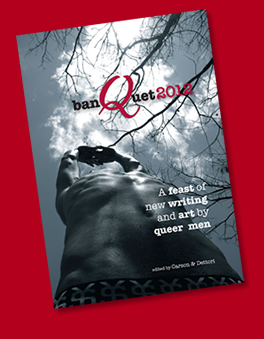
banQuetpress Anthology: Men 2012Our fantastic friends at banQuetpress are searching for stories and artwork for their Men’s and Women’s 2013 Anthologies. They’re also looking for cover art. banQuetpress is Australia’s only dedicated queer publishing house and if you have a short story, poem or piece of art you’d like to see in print, I highly advise sending them your submissions now.

Submissions

banQuet 2013: A feast of new writing and art by Australian Queer Women and
banQuet 2013: A feast of new writing and art by Australian Queer Men

These anthologies showcase a broad variety of innovative, engaging quality writings and art by emerging and established queer writers/artists/photgraphers about GLBTIQ sex and sexualities.

Challenge and surprise us. Introduce us to your complex and flawed queer protagonists and antagonists. Take us for a ride on the seamy side of GLBTIQ lives! We’d love to look at writings and images about queers falling in and out of love or bed!

banQuetpress is especially interested in works that overtly explore a diverse range of:
• sexual expressions/practices
• GLBTIQ cultures (from mainstream gay to queer sub-cultures)
• gender expression
• relationship types
• issues of sex/sexuality particular to the GLBTIQ community

banQuetpress supports community diversity.

Submission Guidelines

banQuetpress will only accept original, previously unpublished material. Please do not submit material that is being concurrently considered elsewhere.
Maximum of three pieces per author/artist.

Submission Deadline: Friday, 18 May 2012

Word Length: up to 3000 words
Art / Graphics / Images: one or a few cells/photos/images/photostory
Short Fiction Guidelines

• Well-crafted, well-written engaging short fiction – short stories, flash-fiction, etc.
• A range of genres, erotica preferred for 2013 edition.
• Scenarios and themes primarily focussed on LGBTIQ erotica, sexualities.

Non-Fiction Guidelines

• Well-crafted, well-written and accurately researched short non-fiction, personal reflections.
• Ideas, issues and information primarily focussed on LGBTIQ erotica, sexualities.
• Reviews and academic essays not accepted.
Comic Art / Graphics / Photography Guidelines

• One or a few cells/photos, one-page comic strip, photostories
• Scenarios, issues and themes primarily focussed on LGBTIQ erotica, sexualities
• Material that can be effectively reproduced/published in B/W and/or colour.
• Resolution quality at least 300dpi.

Style / Formatting Guidelines

• Please do not submit your first draft.
• Submit a ‘clean’ manuscript – that is, a manuscript that has been edited for accuracy and clarity in communication, as well as proof-read for typos. (Works accepted for publication will undergo a full editing and proof-reading process; however, your submission must demonstrate your professionalism as a writer/artist).
• Cover sheet with your legal name (essential), pen name (if applicable), title and word count on it only.
• Name must not appear anywhere on manuscript and artwork (only on cover).
• MS Word document.
• JPEG document for graphics.
• Document Filename should include title of the work.
• Standard 12 point Arial font.
• Double spacing.
• No paragraph indents.
• No headers/footers.
• Use single quotation marks for dialogue.
Cover Sheet – Author / Artist Details

Please include a cover sheet with the following information when you submit your work for consideration:
• legal name (essential) and pen name (if applicable)
• contact details: address, phone, email
• an author/artist biography paragraph (up to 150 words)
• a declaration of originality/authenticity (one per submission). For example: ‘My short story [title] is original work produced by me [name] and has not been previously published and is not currently under consideration for publication elsewhere. Signed, [type in your name].’
Submission Contact Details / Receipt / Notification

• Text submissions: by email as an attachment to admin@banquetpress.com
• Art Submissions: Please send us a link to your work (admin@banquetpress.com).
• You will be notified by mid June concerning the status of your submission


Copyright

• Copyright will remain with you, the author/artist
• Once the work has been published in banQuet 2013, you are free to reprint it elsewhere.
• Please acknowledge that the work was first published in banQuet 2013 in any subsequent reprint of the particular work.
Acknowledgement / Payment

At this stage, banQuet is unable to pay you, but offers:
• one comp copy of the publication
• inclusion of author/artist paragraph biog (including web details if you wish) in ‘About the Contributors’ section
• comp tickets (2) to the publication launchh, writer’s and reader’s event
• promotion of the anthology
• invitations to participate in spoken word performances held by banQuetpress.

banQuetpress are also looking for some amazing cover art–guidelines can be found on their website here.

If you would like to see examples of the work, you can purchase all the Anthologies at Hares and Hyenas, or you can just click the cover images in this post to go straight to the online webstore.

Matthew’s 2011 short story, Mr Perfect, is also available as a standalone eBook over at Smashwords.

Marriage Equality Inquiry Extended

The House of Representatives has quietly extended the deadline for it’s public submissions for it’s Marriage Equality Inquiry until the 20th of April 2012. This means that if you haven’t already submitted your views on Marriage Equality, you should take their survey here.

If you’re wondering what sort of things you might want to say, I suggest looking no further than this post on Single Dad Laughing. It’s a very touching story, and was posted as a direct response to a previous post: I’m Christan Unless You’re Gay. I’ll put an excerpt here:

Hello Mr. Pearce,

I am the Christian mother of a 15 year old teenage boy and about a month ago he came home from school with a copy of your article I’m Christian, unless you’re gay”. The teacher gave his class a homework assignment to read it and write a 500 word essay about “what it meant to them”.

He came home and showed me your article and asked me what I thought about it. I read just the title and became furious at his teacher and at you (even though I know you had nothing to do with her handing out the assignment). Anyway, I confiscated it from him and told him he wasn’t to do anything with it till I had a chance to read it first.

And then I got madder and madder as I read it as I felt like it was a direct attack against our beliefs and our Christian religion and that it was promoting homosexuality, a practice that around here is a huge “sin”.

I gave my son an earful about homosexuality and God and told him that he could tell his teacher that he would not be participating and if she had a problem, she could come talk to me and then I threw the article in the trash. My son didn’t say anything just walked into his room and shut the door.

Long story short, a couple hours later it was supper time and I still hadn’t seen him come out of his room. I didn’t expect it to be that big of a deal to him but I went and knocked and told him to come out, he didn’t answer so I opened his door and he wasn’t there, he had left the house and gone somewhere. Of course I got more mad and tried to call him but he sent it to voicemail. I sent him a text and told him he better get home and he was grounded.

This is the text he sent me in return: “I don’t care. I’m at my friends house writing that essay and I’m not coming home till you read it.”

I think you would have seen steam coming out of my ears if you saw me. I started preparing to go talk to the school the next day. I sent a few angry texts to my son that he didn’t answer. I got the article out of the trash so I could take it into the school and get this teacher fired. My anger got a little out of control and while I was sitting there fuming and planning what to do, I got another text from my son that said “Just emailed it. Love, Jacob.”

My son’s name is not Jacob, and it took me a minute to realize that he was talking about your friend Jacob in your article. And when I realized that I suddenly started shaking in fear and anger at what he might be telling me. I started out of control crying because I couldn’t handle having a gay son and what if that’s what he was trying to tell me? After a long time I finally got the courage to go look at my email and see what he had sent.

For the rest of the post and the letter in detail, visit Single Dad Laughing here. And then head over to the Marriage Equality Survey:

Take the Marriage Equality Survey

Mass Effect 3: The War Asset Number Crunching

**WARNING: THIS POST CONTAINS SPOILERS FOR MASS EFFECT 3**

So earlier this month I promised to do a number crunch to see if it is possible to get the best ending in Mass Effect 3 via the single player game alone, as has been claimed by Bioware’s Jesse Houston. Whether the endings are actually any ‘good’ is a subject of debate, although my feelings are fairly well summed up by this Game Front article, but I wanted to see if Bioware’s claims were true given their own statements, not our judgements. To that end, I asked Bioware via twitter if their definition of ‘Best Ending’ was the Synthesis ending, and to date have not received a reply.

The reason I asked is because there has been some debate on the internet as to what constitutes the ‘best’ ending, with the common consensus being that it is the one where Commander Shepard lives. Although there are  16 confirmed ending variations, although the variations are very slight. Regardless, this is not a discussion about the merits of the ending–rather a question as to whether the ‘Best Ending’ is possible.

The reason this is questionable is because players, by and large, have defined the best ending as the ending where Shepard lives–i.e. where you get the cutscene showing Shepard is still alive. This ending requires an effective military strength of between 4000 and 5000 if you have a high enough reputation (importing an existing ME3 character required) or 5000+ if you do not have a high reputation score. So allowing for a second play through (which is a requirement I would consider unsporting, but in line with the letter of Bioware’s claims), the question is: Can you get over 4000 War Assets in Single Player alone in the base game inclusive of currently available base game DLC? Or taking into account the 50% war readiness: Can you get over 8000 War Assets in a Single Player Game without playing multiplayer

In short: No.

Even if you go back to play through Mass Effect 1 and 2 and make specific choices with the sole aim of maximising your war assets, the best you can get in a single player game is 7729, and without playing any multiplayer to change your war readiness, that gives you a war readiness of 3864.5 (depending on rounding).

In Mass Effect 3, you can get a total of 4819 War Assets irrespective of previous game choices in Mass Effect 1 and 2. This requires taking Diana Allers and using the right Paragon/Renegade choices in her interviews, supporting the militarily effective side of any citadel conversation, doing all the side quests in time and scanning all planets.

You can get up to 2910 points more depending on the choices you make across the Mass Effect trilogy. To get all of these however, you need to do or have done the following:

  • Have saved the council in Mass Effect 1 and had Thane survive Mass Effect 2.

    Standoff with Urdnot Wrex on Virmire

    Want to get both the Krogan and the Salarians? Make sure Wrex dies on Virmire...

  • Recovered all of the Matriarch’s writings in Mass Effect 1.
  • Saved Captain Kirrahe in Mass Effect 1.
  • Killed Urnot Wrex in Mass Effect 1.
  • Allowed Balak to survive the Mass Effect 1 DLC: Burning Down the Sky.
  • Saved the Rachnii Queen in Mass Effect 1 and released her again in Mass Effect 3.
  • Helped most of the Zhu’s hope colonists survive Mass Effect 1. Shiala must have been spared in Mass Effect 1 and helped on Ilium in Mass Effect 2.
  • Completed Kasumi’s loyalty mission in Mass Effect 2 and had Kasumi survive the suicide mission.
  • Jack must have survived Mass Effect 2.
  • Samara must have survived Mass Effect 2.
  • Zaeed must have survived Mass Effect 2 with full loyalty.
  • Jacob must have survived Mass Effect 2 with his loyalty quest completed.
  • Grunt must have survived Mass Effect 2 and you must have completed his quest by killing the Thresher Maw.
  • Mordin Solus must have survived Mass Effect 2 (and likely needs to be loyal).
  • Save all the Normandy crew in Mass Effect 2 (have all the upgrades to the Normandy). Choose to reinstate Kenneth and Gabby to the Normandy in Mass Effect 3.
  • Kept Maelon’s genophage cure data in Mass Effect 2.
  • Collected a large amount of surplus resources in Mass Effect 2.
  • Keep the collector base intact in Mass Effect 2.
  • Completed the Arrival DLC for Mass Effect 2.
  • Completed the Overlord DLC in Mass Effect 2 as a Paragon.
  • Refuse to take Dr. Chakwas with you on the Normandy in Mass Effect 3.
  • Refuse to take Ashley/Kaiden with you on the Normandy in Mass Effect 3 once they become a Spectre.
  • Convince Kelly Chambers to change her identity in Mass Effect 3.
  • Choose to use the Grissom Academy students as Biotic Artillery in Mass Effect 3.
  • Do not save the Turian Colony in the Volus Ambassador quest in Mass Effect 3.
  • Support Admiral Xen over Tali in scavenging the Geth dreadnought in Mass Effect 3–do not rescue civilians.
  • Do not punch Khasila Bint Al Jilani in any of the Mass Effect games.
  • Save Admiral Kal’Zoris on Rannoch in Mass Effect 3.
  • Convince Admiral Raan to rescue Admiral Gerral’s heavy fleet in Mass Effect 3.
  • Convince the Geth and Quarians to stop fighting and both join you in Mass Effect 3.
  • Convince Mordin to sabotage/delay the genophage cure in Mass Effect 3.
  • Get C-Sec to focus on big crimes (Support angry officer and cafe owner in Mass Effect 3).
  • Do not authorise the Alliance private’s transfer at the Spectre Terminal (Mass Effect 3).
  • Do not allow the Asari in the hospital to have a gun (Spectre Terminal, Mass Effect 3).

This is the exhaustive list as far as I can determine, but as you’ll note it does require the sacrifice of a lot of your free willed choices. Even then, it’s not enough. However, if the ‘best ending’ being referred to by Bioware is the Synthesis ending, which is unlocked at an effective military strength of 2800, which would mean, yes there are plenty of war assets regardless of your past history or multiplayer, but brings us right back to the question of ‘is the ending good enough’. Of course, Bioware is expected to bring out an announcement about the planned DLC for Mass Effect 3 any day now, so we’ll just have to wait and see.

MLR Press: Call for Submissions, Christmas and Australia Day Shorts

MLR Press is currently having an open call for Christmas and Australia Day short stories:

Australia Day:

Aussiebum Swimwear

There's more to Australia Day than hunks in swimwear...but hey, it's nice to look at

Australia Day is the Australian version of July 4, it’s when the whole of Australia drops everything and PARTIES to celebrate ALL THINGS Australia. It’s fireworks, festivals, food, beer, ferryboat races on Sydney Harbour, you name it… It’s their national day. Every city puts on the most amazing celebrations.

So here’s your chance if you’ve always wanted to write a story about Australia, help us celebrate Australia Day! Imagine the stories you can write about HOT Aussie men in iconic Aussie locations/scenarios:

– Surf Life Savers on Bondi Beach
– Jackaroo horsemen in the Outback
– Drag queens and HOT men at Sydney’s party of parties the Gay Mardi Gras
– Lovers snorkelling on the Great Barrier Reef
– Romance in Melbourne, the Paris of the southern hemisphere
– Opera at the Sydney Opera House
– The mystical Ayers Rock and the Red Centre
– Love in a hot wool-shearing shed on a sizzling Queensland
– A steamy crocodile safari in Darwin

Now that you’re tantalized with the possibilities…here’s the details:

Stories should be between 5k and 40k

Any subgenre you’d like (but MUST be set in Australia around the celebration)

Due November 5, 2012

Submissions should be sent to special_submissions@mlrpress.com

Christmas Stories:

Christmas Memories

Christmas Memories (2011) by Matthew Lang

H-oohhh-H-ohhh-Holiday Time! Let’s celebrate MLR style! From the sweet to the scorching,
the winter holidays have it all. Whether it’s Thanksgiving, Winter Solstice, Hanukkah,
Christmas, or New Year’s Eve – no matter the holiday if it’s in the winter months,
let’s celebrate it!

Stories should:

– Be set around a winter holiday between Thanksgiving (US) and New Year’s Eve
– Be between 5k and 40k
– Any subgenre is welcome

Deadline for submissions: August 15th, 2012

Submission should be sent to winter_holiday_subs@mlrpress.com.